
In a few weeks, Google will unveil its annual ranking of the most popular keywords of the year. Where will ChatGPT rank in this list? In 2023, OpenAI's conversational AI was at the heart of debates, sparking user wonder, presenting impressive applications, and causing a technological breakthrough in artificial intelligence usage. However, it was also at the center of controversies regarding plagiarism, intellectual property, and AI limits. For the first time in many years, Google was disrupted. Users can now get answers to their questions without needing Google. The impact of OpenAI's attack was like a mosquito bite that wakes its victim in the middle of the night. Indeed, the search giant seems to have dozed off, with a user experience on its search engine that has barely evolved. Furthermore, Google Assistant still struggles to perform simple tasks, like creating reminders, providing accurate sports results, or giving the weather.
As is often the case, the market leader hesitated to disrupt the established order, as this order allowed them to maintain their dominant position.
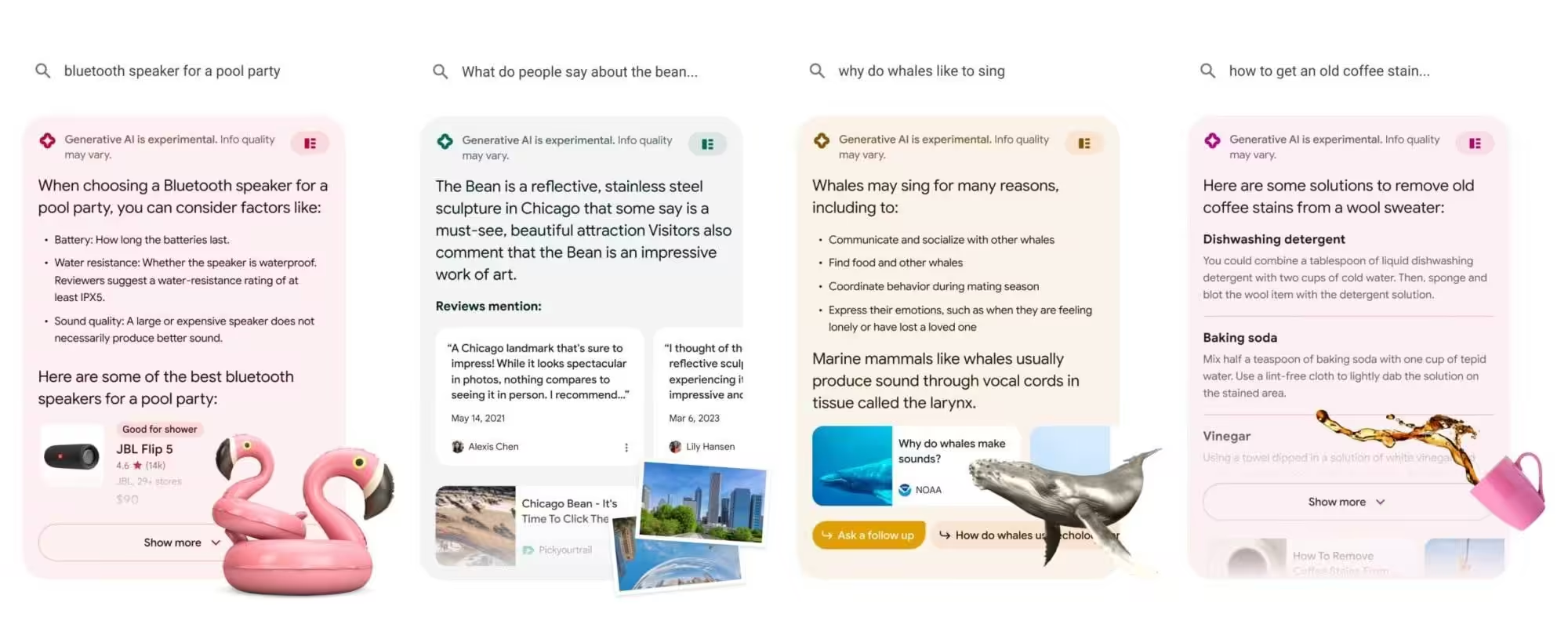
However, the game has changed. Facing this attack on its own turf, Google is currently working on a response with the development of its update called SGE (Search Generative Experience). Currently in testing phase in the United States, India, and Japan, this conversational interface allows users to obtain answers formulated in natural language.
The AI-generated response box now occupies a prominent place between sponsored results (SEA) and natural results (SEO). If the relevance of AI-provided responses is proven, it could satisfy both users and Google by reducing the incentive to use ChatGPT or Bing. Google could thus maintain its dominant position. Conversely, website publishers could be directly affected, as interest in consulting their content might decrease, with Google already extracting the essential information. This major evolution of the search experience could be deployed in France at the beginning of 2024, or even by the end of 2023. Change is imminent.
Publishers once again face a difficult choice imposed by Google. If they accept the conditions, Google will appropriate their content and a significant portion of their traffic. If they refuse, their competitors will take what remains of the pie. In either case, the share of Internet traffic to be distributed will be reduced, with fewer intermediaries. Google generally justifies these changes in the name of user experience and provides tools to authorize or prohibit the use of their content. There are several notable precedents, including featured snippets, discussions around Google News and neighboring rights, as well as Google Shopping, which was considered an abuse of dominant position by the European Court of Justice.
Publishers are aware of the challenges they face. Particularly those whose business model relies on buying guides and affiliate marketing are vulnerable. They depend heavily on natural search and risk losing about 80% of their traffic due to the Google SGE update. Ultimately, this could translate to a similar loss of revenue. Traffic sources appear less frequently in SGE box results, and users have less incentive to consult them, as much of the answer is already formulated, sometimes with elements from Google Shopping. To mitigate this impact, some solutions are being discussed, but their implementation will depend on negotiations between Google and publisher associations, or even potential judicial decisions.
Discover for information, Google Shopping for conversion ?
One solution could come from Discover, a personalized article feed developed by Google for several years, accessible exclusively on mobile. It offers another way to access content and has become an important traffic source for many publishers. We're currently seeing interesting developments in this area: initially, Google highlighted very recent articles, dating back at most a few days. However, it now doesn't hesitate to propose older articles (some over 10 years old) that are relevant when users suddenly show interest in a new topic. Among these articles, we find buying guides, comparisons, informative content, as well as full pages dedicated to a particular subject. These developments align with natural search optimization practices. Publishers could thus recover some of the traffic they risk losing with the SGE update, especially since Google is currently testing Discover integration on desktop computers.
However, these contents are often consulted via Discover at the very beginning of the purchasing process, when users aren't yet ready to make a purchase. They're still in the research phase, consulting reviews on different articles, whether on Google or other apps like TikTok or Instagram, before perhaps conducting a Google search to find the site offering the best price. In this case, the transaction could easily be attributed to Google or its Google Shopping service, in a world where it will become increasingly difficult to compensate all actors who influenced the purchasing act. These mechanisms are hard to predict, as they're just examples of possible experiences and don't necessarily reflect reality as of October 2023. The real impact of Google SGE can only be evaluated after its public launch, but many publishers risk suffering significant losses, particularly those who haven't diversified their traffic sources and revenue streams.